Thursday, October 10, 2013

Arthur Henry Paterson, The Better Man (1890)


This novel may qualify as the first western, and it was written by an Englishman. The central characters of the novel are also English, and the author writes as someone who acquired a familiarity with the people and customs of the American West. He lived there for a time in the 1870s.

Plot.  Two school chums, who first met as schoolboys at Eton, meet again in a settlement called Toros in New Mexico. Frank Houghton has lived here as a cattle rancher for four years. He is joined by the younger Tom Eckersley, who has left his upper-class family to seek his fortune in America. Against the advice of Houghton, Tom befriends a shady character, Mark Galt. With the help of an unscrupulous judge, Galt and his gang run a town 50 miles away called Carita.

Confident in his ability to judge character, Tom signs a contract that commits him to a year of sheepherding for Galt. When Tom also agrees to persuade his father to invest £1,000 in their ranch, he does not sense that Galt is laying a trap for him. But eventually, he is so enraged by Galt’s duplicity he nearly kills the man.

Apprehended before he can flee to safety, he is thrown in jail and faces attempted murder charges. Frank gathers a small army of cowboys to ride all day and night to rescue Tom, who has been found guilty in a hurried trial and sentenced to be hanged. The rescuers meet little resistance, and the crooks are quickly overwhelmed and sent packing.

Tennyson's home, from book by A. Paterson
Romance. Midway through the novel, Tom’s family arrives in Toros to take him back to England. With his parents is his sister, Edith, whose presence disturbs the already taciturn Frank. He had once proposed marriage to her, and she declined his offer. She is now being courted by a military man, Major Crawford, who arrives in town as well.

Frank is not a happy soul, still suffering from a broken heart. Edith’s arrival revives his hopes, but she remains unaware of his feelings, and hardly knows her own. Belatedly discovering her love for Frank, she turns down Crawford’s proposal of marriage.

When a young telegraph operator observes the major’s abrupt departure from town, he sends word to Frank who returns from his ranch just as the family is about to leave for England. Frank and Edith are united once more, this time confessing their love, and he promises to wrap up his affairs within three months and return to England himself.

Character. Before we meet Frank Houghton, a crusty old stage driver describes him warmly as “a man!” By that he means a trailblazer, “one who cuts a notch in every tree he passes as he walks through life.” Frank has been transformed by his four years in the West. Already a big man at six-foot-three and a half, he has developed a massive chest, his skin has browned, and he has grown a thick beard.

Someone observes that the West has been hard on Frank. Edith tells him he has “a tired, grim look, as if you did not find life very much worth living.” She guesses that it must be lonely with no one to speak to but the men who work for him. He tells her he can bear it, because he’s a man and he has no choice. Meanwhile, he has won a place in the hearts and minds of the local residents. Through his courageous effort, he has helped rid the town of a ring of crooks and outlaws.

Tuesday, October 8, 2013

Cowboys in early frontier fiction


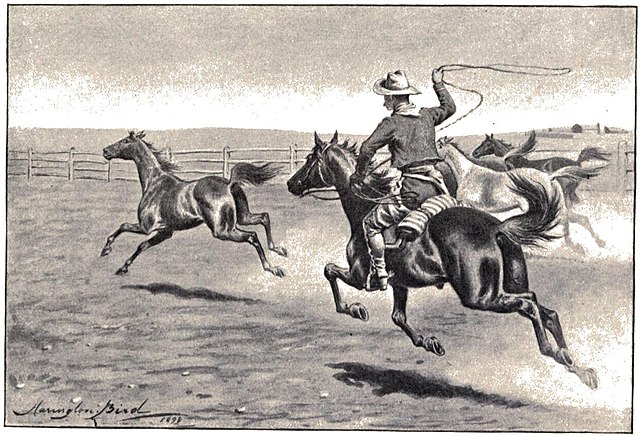
Cowboy, 1898
The cowboy western originated with the dime novels of the nineteenth century. These were exaggerated tales of adventure in the Wild West. But when did cowboys first appear in mainstream popular fiction?

Vaqueros. In early examples, set in California, they appear as vaqueros, and remind us that the actual horsemen who herded cattle in the frontier West were itinerant agricultural laborers. In Maria Amparo Ruiz de Burton’s The Squatter and the Don (1885), a californio ranch owner has vaqueros among his employees. They figure into the plot as a herd of cattle are driven through a winter storm in the mountains above San Diego. 

A foil to the central character of Gertrude Atherton’s Los Cerritos (1890), Carlos Castro is the chief vaquero at a neighboring ranch. He is a burly giant of a man, so full of energy he is like a volcano waiting to erupt. His comrades adore him for his “enormous vitality” and his “rude magnetism.” Though a horse thief, he is always acquitted of any crime. He is opposed to americanos moving onto California rangeland, picks a fight with and grievously wounds one of them, and sets fire to his ranch.

Ranch hands. English-speaking cowboys make an early appearance in Charles King’s Dunraven Ranch (1890). They are employed on a mysterious ranch located near a cavalry outpost in Texas. Eager to solve the mystery, a young lieutenant pays a call with several troopers, who are of Irish descent. The visit develops into a donnybrook between the cavalrymen and the ranch hands, who are English.

Three ranch hands are minor characters in Marah Ellis Ryan’s Told in the Hills (1890), set in western Montana. Jim the youngest is an innocent, who gets excited when the cavalry arrives to set up camp near the ranch. Another, Andrews, is occasionally sent to the nearest settlement for the mail, but tends to stay overlong and come home drunk.

Cowboys are a “wild combustible element” in Arthur Paterson’s A Better Man (1890). They gather in numbers in the saloon of a New Mexico frontier settlement. Some are given to drunkenness and insulting women. The novel’s central character, a rancher, assembles a small army of them to ride all day and night to rescue an innocent man, who has been found guilty in a hurried trial and sentenced to be hanged.

Cowboys. Owen Wister may have popularized the cowboy, but in his early western stories written for Harper’s and collected in Red Men and White (1896), they are dubious characters. Two crop up in “A Pilgrim on the Gila.” The story’s narrator learns that one of them is avoiding a woman who is two months shy of claiming him as a common-law husband. Later, the two cowboys are among a dozen road agents who hold up an army paymaster and make off with the strongbox.

The Great K&A Train Robbery
The cowboys in Paul Leicester Ford’s The Great K&A Train Robbery (1897) talk in stereotypical lingo. Asked if he is carrying a weapon, one responds, “Do I chaw terbaccy?” Threatening another man, one calls him a “stinkin’ coyote” and tells him to stay put “or I’ll blow yer so full of lead that yer couldn’t float in Salt Lake.”

Colorful, yes, also ungovernable and potentially dangerous. They are frequenters of saloons, eager to accept a wild rumor as fact, and quick to rush a suspected wrongdoer to justice. Believing the young hero of the novel to be a train robber, they try to lynch him from a telegraph pole.

Cowboys of a similar stripe appear in two of Cy Warman’s Frontier Stories (1897). Given to gunplay and playful troublemaking, they can easily find themselves on the wrong side of the law. In one of them, several cowboys play a trick on a band of Indian cattle thieves. Finding the cremated remains of one of them, they leave a handwritten curse in the man’s skull that frightens the thieves away.

Warman’s “A Cowboy’s Funeral” starts out with some hijinks of a half-dozen cowboys, who have ridden 200 miles to a town in Utah to mail a letter. They get drunk and start firing their pistols until a bystander is accidentally shot and killed. They make a hasty retreat into the desert, but when the sheriff gives chase, one of them is shot dead.

When the cowboys put enough distance between themselves and the law, they stop and make camp. There they pass the bottle before eventually putting the dead man into a grave. One cowboy leads them in a version of “The Streets of Laredo,” which the narrator describes as “plaintive and pleading—a sort of mixture of negro minstrel and the old time Methodist revival song.”

Monday, October 7, 2013

Thomas D. Clagett, The Pursuit of Murieta


This novel is a lot like a Budd Boetticher western. It has the structure of a movie plot, and much of the action takes place a good distance from civilization. A group of male characters deal with life and death issues like what to do with and what to believe about a man they have captured. And a woman riding with them has an agenda of her own.

Plot.  At the center of the story is real-life Mexican bandit Joaquin Murieta who harried the americanos flooding into California after it became a state. Something of a Robin Hood, he reputedly stole from the wealthy to distribute among the poor. He was a popular hero among the disenfranchised and a pain in the backside of law enforcement, which found itself plagued with not one but several “Joaquins” roaming the state.

The story begins with a scene of unprovoked yanqui violence against Murieta and his wife as they attempt to return to Mexico after an unfruitful sojourn in the California gold fields. Then it jumps ahead to 1853 during a few days in which Murieta is pursued by a contingent of rangers tasked by the governor with bringing him in. They finally run him down in the mountains above San Gabriel Mission.

Lt. Ambrose Quick, the young man in command, has trouble keeping order among his men and deciding whether to believe their captive when he claims to be Murieta. Addie Moody, a saloon girl who has joined them has revenge in mind. Her sister was raped and killed by a man she believes is Murieta.

Style and structure. Like a movie, the novel has a single central conflict, pitting two men against each other: Murieta and Lt. Quick. One of them is more admirable than the other, but neither of them is a villain. That honor goes to one of Quick’s men, Ned Needle, who is a hateful bigot, driven by sneering contempt for everyone.

As in a movie, the characters tend to be types whom we quickly recognize. Besides the bigot Needle, there’s a drunk, a self-important sheriff, his featherbrained daughter, and a mysterious Mexican woman. Addie Moody is the outspoken prostitute with more intelligence than any of the men. Besides Lt. Quick, only one of them actually breaks out of the pattern created for them and makes a choice that amounts to a change in their character.

Quick is interesting for starting out a man with aspirations far beyond his capacity to achieve. He wants to be mayor of Los Angeles, but has no qualifications for the job. He hopes that capturing Murieta will sweep him into office. Before the story is over, he makes some difficult decisions and some unwelcome discoveries that both lift and lower him in our estimation.

Many of the characters in the novel are based on actual historical figures. Ten or more of them walk from the pages of history. Maybe most surprising is to find “Judge” Roy Bean running a saloon in the little settlement of San Gabriel. Andres Pico, retired Mexican general runs horses on the verdant ranges of the San Fernando Valley.

Saturday, October 5, 2013

Glossary of frontier fiction: C
(cab - catch a tartar)


Below is a list of mostly forgotten terms, people, and the occasional song, drawn from a reading of frontier fiction, 1880-1915. Each week a new list, progressing through the alphabet, “from A to Izzard.”

cab = baby carriage. “She took the baby out in his cab to hive him the sun and air.” Elizabeth Higgins, Out of the West.

cabbage = to pilfer, take possession of by stealth. “‘I can see Briggs City eatin’ the shucks when it comes ’lection day,’ he says, ‘and that Goldstone man cabbagin’ the sheriff’s office.” Eleanor Gates, Alec Lloyd, Cowpuncher.

caboose = a cookhouse; oven or fireplace. “With tape-line and pegs McKenna laid out the ground plans of bunk-house, eating-camp, caboose, foreman’s quarters, and stables.” A. M. Chisholm, The Boss of Wind River.

calcium light = limelight; a lamp consisting of a flame directed at a cylinder of lime with a lens to concentrate the light; formerly used for stage lighting. “There will be no villain clothed with a little temporary power to shut the calcium light out of these putrid beds of corruption.” John C. Bell, The Pilgrim and the Pioneer.

calf’s head jelly = head cheese; a meat jelly made with flesh from the head of a calf or pig and often set in aspic. “It is a good thing, I tell you, ladies and gentlemen, a very fortunate thing, that I am so amiable, and Gabriel so good a fellow, or else I would have punched his head into calf’s head-jelly, twice a day, many times.” Maria Amparo Ruiz de Burton, The Squatter and the Don.

Calumets
call the turn = to predict accurately. “That either they or I can learn / A sinner how to call the turn.” William De Vere, Jim Marshall’s New Pianner.

calumet = a highly ornamented ceremonial pipe used by Native American tribes, a  peace pipe. “As the circling smoke rings rose from the sachem’s calumet, the gentle breeze bore them slowly to the southward.” G. Frank Lydston, Poker Jim, Gentleman.

calzones = breeches, pants. “It appears that he had only has dirty cotton calzones to be buried in, so his wife begged a worn white suit from Mr. Benson.” Herman Whitaker, Over the Border.

Camilla = from Roman legend, a woman warrior who fought on the side of Turnus against Aeneas. “But the sudden shadow of a coyote checked the scouring feet of this swift Camilla, and sent her back precipitately to the buggy.” Bret Harte, Frontier Stories.

camp robber = a jay of northern North America with black-capped head and no crest; noted for boldness in thievery. “A camp robber was screaming on a cedar bough above the prostrate figures.” Cy Warman, Frontier Stories.

Thursday, October 3, 2013

How to write like Elmore Leonard:
Gunsights (1979)


2002 edition
Elmore Leonard’s 10 rules of writing have been circulated widely on the Internet, but they are more obfuscation than revelation about the art and craft of writing fiction. Reading one of his westerns, Gunsights (1979), you can begin to glean what makes his novels so good.

In this novel, two men are on opposite sides of a conflict between a mining company and a scattering of settlers on an Arizona mountainside: Apaches, Mexicans, and former 10th Cavalry regulars. The two central characters were at one time friends and partners, and the novel begins in Sonora with their retrieval of an Apache chief and a white girl.

While there, they are involved in the shooting of a gang who have been after the same chief to collect a large bounty. Now one of the two former partners is employed by the mining company attempting to drive the settlers out of their homes. The other is an Indian agent, defending them.

This could be a set-up for a conventional western novel, the two men now enemies—one of them turned villain as he works for the mining company, the other heroically serving the cause of justice until there’s a final shootout. Well, that’s not what happens. It’s much better, and here are some reasons:

Strong characters. Leonard’s characters are not the usual stock characters found in traditional westerns. You cannot anticipate what they are going to do or say. That’s because they are smarter than you and me, and their intelligence is mostly intuitive.

1979 edition
Characters in this novel get into trouble when they think too much. It may only be a split-second thought before firing a gun, and the delay makes the difference between life and death. The ones who survive act when the feeling is right and wade in without knowing what’s coming next, just trusting their instincts. Thus, when they act, we are likely to be surprised by what they do.

Part of their strength as characters is their age. They are not youths as is often the case in conventional westerns. Bren Early and Dana Moon, the two central characters, are in their 30s. They have already grown up.

Plot. Characters like this drive a plot. Leonard plays with this idea by casting a group of newspaper reporters who have come to Arizona for a particular story. For them, the “plot” they are after is the conventional one—an armed confrontation between two men who used to be friends and partners.

But the two men refuse to cooperate because they are not enemies and have other priorities. For one thing, they don’t want to be bothered. For another, they have a mutual enemy in a third man from that incident south of the border a dozen years ago—a man they thought was dead. Looking for the plot they expect to develop, the news reporters continually miss what’s going on under their noses.

Villains. Leonard’s villains eventually die because they are ignorant. They can be brutally cold-blooded and therefore scary, but confronting a foe who isn’t afraid of them, they are at a disadvantage. If that foe is smart enough to outwit them, they are stymied. And if they are dumb enough to make a stupid mistake, like pay too little regard to a woman with a shotgun, they are dead men.

The conventional western often uses vengeance as the motivation for the main character’s actions. And the villain is finally avenged for some horrible misdeed. In Leonard’s novel, revenge is what’s driving the villain. He wants payback for a nasty gunshot wound that narrowly killed him and left him with a disfigured face.

Wednesday, October 2, 2013

Loren D. Estleman, The Adventures of Johnny Vermillion


“This is an entertainment,” we’re told midway through this novel, “not a historical tale.” And entertaining it is, not only the story it tells but the way it is told. Estleman indulges a penchant for droll humor and clever wit as he follows a troupe of actors roaming the West and robbing banks. Played against a backdrop of actual historical events and figures, their story also has a persuasive ring of verisimilitude.

Johnny Vermillion is the stage name of the lead actor and brains behind The Prairie Rose Repertory Company. On their tracks is a Pinkerton detective, who has persuaded his boss—Allan Pinkerton himself—to let him leave his desk job and try his hand in the field. Also in hot pursuit is a gang of cold-blooded outlaws, upset that the Prairie Rose is giving them stiff competition.

Plot. It is 1875, a year in that sliver of time between the Panic of 1873 and the Little Big Horn. Johnny Vermillion, son of a Democratic party boss in Chicago, comes by thievery as easily as any young man following in his father’s footsteps.

Gem Theatre, Deadwood, 1878
A small troupe playing multiple roles, the Prairie Rose players are able to carry out a robbery during the performance of a play. One of them slips out of the theatre for the few minutes it takes to hold up a bank employee at gunpoint. You can say they take suspension of disbelief to the next level. The theatre audience, believing their own eyes and what’s erroneously printed in the program, never notices the absence of a cast member.

Philip Ritterhouse, the Pinkerton detective, is not so easily fooled. He has an obsessive attention to details that reminds one of Sherlock Holmes. By reading coverage of the string of robberies in local newspapers, he discovers the odd coincidence of the Prairie Rose’s appearance in ads and reviews on the same pages. Putting two and two together, he sets out to capture them.

Black Jack Brixton’s gang crosses paths with the company in Salt Lake City, when he and his men show up a day late to rob an express office. The money is already gone. During a summer hiatus, while the gang retires to Mexico, the actors disperse to parts unknown, and Ritterhouse sets a trap for two of them by posing as a booking agent. At the start of the next theatrical season, all are fated to be reunited in the dressing room of a theatre in Wichita.

Opera House, Iowa City, Iowa c1875
Style.  In this and other westerns by Estleman, humor and irony dominate a playful narrative style. The opening pages evoke the legendary West with a catalogue of the genre’s clichés and conventions. It’s a West that should have been, we are told, but never quite was. And what follows is a clever mix of historical fact and fancy.

Much of the fun is in the narrative voice used to tell the story. Tense switches from past to present and back to the past again. There is occasional use of the second person: a pot of coffee is so strong “when it’s poured you could tie a knot in the stream.” And there’s liberal use of first person plural: “We shall meet him in the flesh presently.”

Generic conventions are acknowledged: “Marshal Fletcher was forty and unpleasantly fat, a fixture in outlaw tales of this type.” In a Denver pleasure palace, “the usual chubby quartet gallops in sparkling leotards onstage.” Meanwhile, common knowledge is noted: “Lazy fat men are commonly dismissed as cowardly and stupid.”

Tuesday, October 1, 2013

Revise, revise, revise: nitpicking


Working with my own personal copyeditor, I’ve just finished the third draft of the book I’m putting together on early frontier fiction. I would have said “the book I’m writing,” but it’s at the stage now where “putting together” is more like the task that revising feels like. Some assembly required.

I’m now looking at a list of terms I need to make sure are used consistently:

couple of – My copyeditor points out that it’s not just couple, as in a couple people.

barb wire – Other forms of this term are OK (barbed wire, barbwire); I just need to stick with one.

Cavalry / cavalry – Use one when I mean the U.S. Cavalry and the other when I’m just referring to a company of mounted soldiers.

nonwhite – It’s not non-white.

backstory – It’s not back story or back-story.

kind of – Delete when it’s a hedge phrase (e.g., kind of angry).

Populist / populist – Capitalize when it refers to the actual political party.

en dashes – Use these instead of hyphens in date ranges (e.g.,  1910 – 1915)

s’ / s’s – Either is right for possessive case of plurals; I prefer s’ and just need to check for consistency. What I’m still not sure about is whether the same rule applies to a singular word ending in s (e.g. the name Adams).

dance hall – Always two words, not dancehall.

half-dozen – Takes a hyphen.

East / West. A big headache so far has been deciding when to capitalize these two words. The manuals say to use capitals when you are referring to a region with its specific culture and customs. So the East and the West are easy, and a little less so is back East and back West. But things get murky when combined with other words. Is it came West or came west? And when is it Western or western? Westerner or westerner? I still don’t have a rule for these nailed down.