Thursday, December 19, 2013

Ed Gorman, Blood Game (1989)


This hard-boiled "midwestern" is set in the summer of 1892 in some unnamed city big enough to turn out over 4,000 fans for a nasty boxing match. The focal character is Leo Guild, a 55-year-old bounty hunter convinced by a boxing promoter to help stage a fight between a white man and a black man. A bloodthirsty crowd is expected, believing they’ll be witness to a killing in the ring—and not the killing of the white fighter.

It’s an ugly set-up, and Guild has seen enough of the world to know it’s not much different from what passes for everyday human behavior anywhere. Stoddard, the promoter, is a tyrannical blowhard, loved only by a loyal son, Stephen, whom he abuses and scorns.

The white fighter, Victor Sovich, is equally hateful. Given to insane rages, he abuses women and boasts that he likes to kill people. One young fighter died during a bout after Sovich poisoned him to slow him down in the ring. His opponent in the upcoming match is a Franklin Rooney, a man past his prime whose only aim is to survive the fight. The longer he can stay upright, the more he gets paid. He only half understands that the crowd has gathered to see him die.
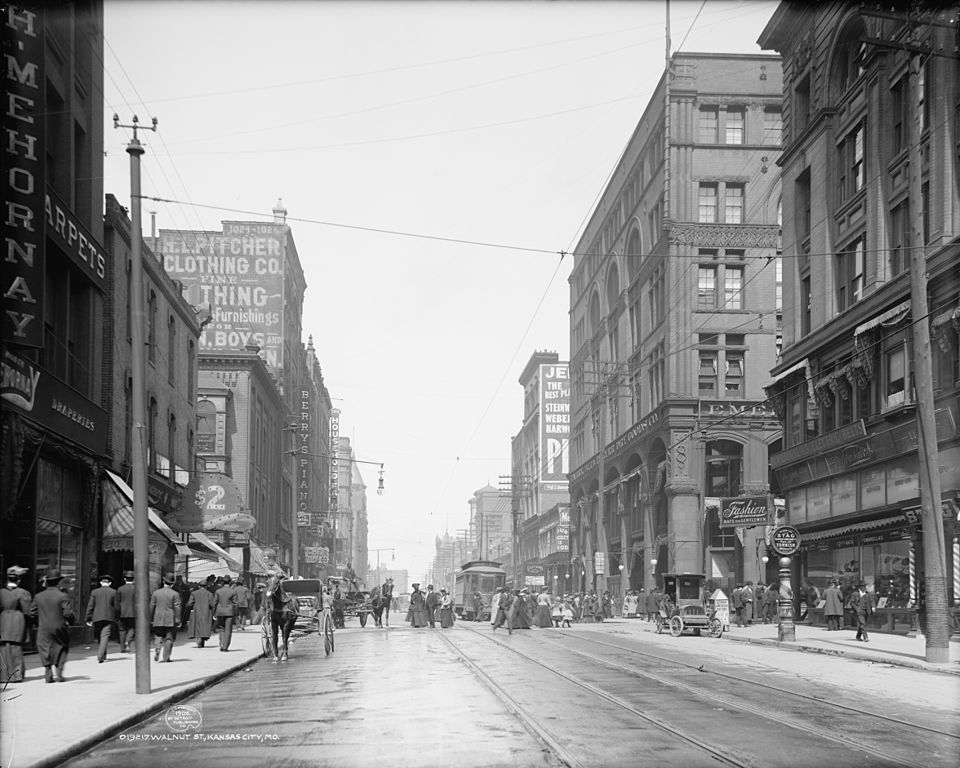
Kansas City, Missouri, 1906
Guild meets a pistol-packing mama, Clarise Watson, intent on avenging Sovich for the poisoning of her brother. Guild, unconcerned by their difference of color, maneuvers to keep her out of harm’s way. Also keeping her company with hotel breakfasts and after dark walks, he discovers her to be a consenting adult.

Stoddard hires Guild to guard the day’s take during the fight. He has promised Sovich to split it with him, but hires a thief to conveniently steal it. Sovich will get nothing, and Guild is intended for a bullet during the robbery. By mid-novel, death is in the cards for several characters, and however it plays, you know it will all end in tears. Which it literally does.

Tuesday, December 17, 2013

Dallas (1950)


I’ll start with the one good thing I can say about this muddled western—Gary Cooper. His face is often the only sign of life on the screen, while the clichés, crazy plot turns, and groaners pile up around him. 

Plot. The plot of this film is not so much contrived as simply a chopped salad of worn out story ideas from B-westerns. It’s a confusing mix of revenge, switched identities, a love triangle, a Confederate colonel who has never surrendered, the theft of a ranch, rustlers, a villain pretending to be an upstanding citizen, a sociopath killer, and lots of shooting and chases on horseback. 

With several characters pretending to be someone else or someone different, I was often unsure about who knew what about whom. I admit, it was late in the day and I was not at my sharpest, but it was all more than I could keep track of.

Cooper. I give the guy credit for holding his own in this one. As long as Cooper was on the screen, a scene seemed to be clear, even when it wasn’t. I finally just took to watching him, as you do when a situation is puzzling and you look for someone who acts like they know what’s going on.

Gary Cooper, Ruth Roman
An unexpected twist involved a black cat that we see Cooper absently petting for a while—something I don’t recall ever seeing in a western before. It seemed like a wonderful throw away detail, even as the cat appears on a windowsill next to Cooper during a gunfight. Then the script has him step on its tail to get a reaction out of the other man. A long build-up to a cheap trick. Argh.

A viewer might argue that the film is meant in part to be a comedy. It opens with a gun duel in the street between Wild Bill Hickok and Gary Cooper’s character. It’s an attention grabber if we know that Hickok died in Deadwood, playing cards. But Cooper is the star of the movie and can’t expire in the first reel either. Though shots ring out and Cooper drops to the ground, looking dead, it turns out to be a ruse. Not all that clever, but it gives you hopes for a movie that never quite lives up to that moment again.

Monday, December 16, 2013

Alfred Wallon, Showdown in Abilene


Review and interview

Originally published in 1981—in German—Showdown in Abilene was the first novella in Alfred Wallon’s Rio Concho series. Published now for the first time in English by Piccadilly Publishing, it’s in many ways a love letter to the American West.

Plot. With an abbreviated story that could well fit neatly into a one-hour TV western episode, Wallon introduces readers to a trail boss, Jay Durango, and his crew of cowboys. They have just arrived in Abilene, Kansas, after a summer-long cattle drive from Texas.

Encouraged to have a good time in town by the marshal, Bear River Tom Smith, but to stay out of trouble, the cowboys make an attempt to comply. But under the influence of too much alcohol, they cause a disturbance at the Opera House. Before long, they’re cooling off in jail.

More serious trouble is in store for Jay Durango. A pair of villains abduct him and hope to leave him dead in a shadowy corner of the red light district. Arson figures in to further plans for a bank robbery while a section of town burns. Bullets finally fly proving once again that crime rarely pays.

Railway, Abilene, Kansas, c1867
Pleasures of the text. There are many things to enjoy about the story and the storytelling. In Wallon’s hands a reader senses the pleasure of spinning a yarn from the familiar elements of the material. His characters are not only full of life. They are sketched in with hints of backstory that make you curious about them.

Durango, for instance, has what seem to be troubled memories of soldiering for the Confederacy. Returning to Texas, he’s in hopes of a new beginning. Billy Calhoun, the young son of the rancher he works for, was for two years abducted by Quanah Parker’s Comanches. He rankles at Durango’s attempts to supervise him. There’s even brief reference to a black cowboy, Bob Rennington.

Sunday, December 15, 2013

One sentence journal, Dec. 8–14


Time marches on . . .
Stormy weather

12/8, Sunday. Stormy weather, cold wind and clouds rolling over the mountains from the coast, with snow in the high elevations but dry here on the ground—living in a rain shadow.

12/9, Monday. Department of Where Has the Time Flown: Watching Johnny Mathis sing a Christmas song on The View this morning and remembering a concert in Chicago in 1961 when we were both in our 20s.

12/10, Tuesday. With the rest of the country and Canada in a deep freeze, it seems hardly right to complain about 38 degrees outside this morning, so I won’t.

12/11, Wednesday. Starting into chapter 1 of a western in German that begins: “Als Jim Whittaker über den Pass kommt, kann er das lange Tal unter sich bald immer besser übersehen.”

12/12, Thursday. A strip of half-inch weather stripping has finally found its way to the top of a door at the back of the house, and I’m waiting for the next cold snap to see if the room feels any warmer.

12/13, Friday. Edgar Allen Poe notwithstanding, the ravens here in the desert always sound to me like they’re laughing to themselves about something—and just like it’s gallows humor.

12/14, Saturday. Community Service Department: On walks in the desert, I’ve stopped picking up other people’s trash.


Image credits: Ron Scheer

Coming up: Alfred Wallon, Showdown in Abilene

Saturday, December 14, 2013

Glossary of frontier fiction: F
(flannel cake – forced draft)


Below is a list of mostly forgotten terms, people, and the occasional song, drawn from a reading of frontier fiction, 1880–1915. Each week a new list, progressing through the alphabet, “from A to Izzard.”


flannel cake = a flat cake of thin batter fried on both sides on a griddle. “Billy pronounced the flannel cakes superior to flapjacks, which were not upon the bill of fare.” Owen Wister, Lin McLean.

flannel face = loudmouth, braggart, one who talks much to little effect. “‘Damned scoundrel’ sliden’ from yer flannel face is like a coyote roundin’ on a timber wolf.” Ridgwell Cullum, The Story of the Foss River Ranch.

flannel-mouthed = slow talking; loud; boasting; characterized by deceptive speech. “You ask for dirty work to be done, an’ when that dirty work’s done, gorl-darn-it you croak like a flannel-mouthed temperance lecturer.” Ridgwell Cullum, The Story of the Foss River Ranch.

flapper = an arm, hand. “Y’u see, I get him in the flapper without spoiling him complete.” William MacLeod Raine, Wyoming.

flat head = a stupid, foolish person. “I enjoyed myself first rate, an’ upset a couple o’ delivery wagons because they wouldn’t make way for me, roped a runaway steer ’at had the whole town scared, an’ chased a flat-head clear into the Palace Hotel.” Robert Alexander Wason, Happy Hawkins.

Thursday, December 12, 2013

James Welch, The Indian Lawyer


First published in 1990, this is a thoughtful and suspenseful novel by a Native American writer from Montana. I had previously read his Winter in the Blood (1974) and The Death of Jim Loney (1979). All three novels concern the complexities of living as an Indian in a white-dominated world.

Unlike the struggling social cast-offs in the earlier novels, the protagonist of The Indian Lawyer has by all appearances successfully assimilated to white culture. Sylvester Yellow Calf has parlayed statewide recognition on the high school basketball court into a university education and law school. He is now one of the rising members of a high-end law firm in Helena.

With influential friends, he may well rise further from his humble origins on the Blackfeet reservation, where he was abandoned by parents and raised by a grandmother. Early in the novel he is approached by a member of the Democratic national committee to run for Congress.

His pleased but almost diffident response to that offer signals something not quite substantial in the identity he has assumed as a promising young lawyer. Beneath his confident surface is an uncertainty that the reader suspects and that he is mostly unaware of. The break from his reservation past has left him without either real roots or clear ambitions. Despite his achievements, he remains an outsider.

Blackfeet reservation, Montana
Single, he has known a good many women in his short life, and his current girlfriend is the daughter of a rancher and former Senator. While she is ready for a deepening relationship with Sylvester, he remains tentative, conscious of the disapproving glances of whites when the two are out together in public.

He lets her slip away, as he has done earlier with a high school counselor he was once fond of. Sliding into what seems to be an old groove, he violates all professional standards by allowing himself to be sexually intimate with a new client. It may be an old groove for him, but it’s also thin ice.

Tuesday, December 10, 2013

The Law and Jake Wade (1958)


This noir western from director John Sturges is smaller scale than his big films (Gunfight at the OK Corral, The Magnificent Seven), but a quietly intense gem. Richard Widmark leads the cast in a role that recalls the grinning malice of the hoodlum he plays in Kiss of Death (1947). Robert Taylor, dressed in black, is the handsome marshal who was once his partner in crime.

Plot. Taylor, in an act of good will, leaves his post in another town to spring Widmark from jail. He expects enough gratitude to let bygones become bygones. But Widmark isn’t easily appeased for what he considers as Taylor’s betrayal when he “ran off” after their last bank job, taking the loot with him.

It is buried now somewhere in the desert, and Widmark isn’t about to let matters rest. He wants the money. He and his gang take Taylor and his girlfriend (Patricia Owens) hostage across mountain and valley to retrieve it. Once that is accomplished, it’s not clear whether he intends to let either of his captives live.

Taylor and Owens manage to make an escape, plummeting down a dusty slope and making off on foot along a ravine, but Widmark soon intercepts them. Then their progress is interrupted when they are stopped by a small company of cavalry, whose lieutenant warns them of a band of renegade Comanches roaming the hills.

Widmark, Owens, Taylor
Undaunted, they continue to their destination, which turns out to be a ghost town, where Taylor has buried the money in the cemetery. With the end game in sight, matters take an ominous turn as the Comanches wage a night attack that has them all fighting for their lives. Morning light brings burial of the dead and there’s a final resolution to be reached between Widmark and Taylor.

Highlights. I’m calling this a noir western because many scenes take place at night. Most of the characters are outlaws, each with his own sinisterly dark persona. Particularly menacing is Henry Silva with the occasional leering comment directed at Owens. There’s a hard-boiled edge to the dialogue, as when Middleton is asked whether any words were said over the graves of the men he just buried. “Yeah, goodbye,” he says.

The performances are fine with Widmark and Taylor well matched as adversaries. The supporting cast is also strong. Besides Owens, who easily holds her own in the company of desperadoes, there is the wonderful character actor, Robert Middleton, as a man with torn loyalties. Shot in Death Valley and the Alabama Hills of Lone Pine, California, the film is a Cinemascope travelogue capturing the scenic beauty of the Sierras under winter snows.