Showing posts with label john reese. Show all posts

Thursday, January 23, 2014

John Reese, They Don’t Shoot Cowards (1973)


In a John Reese western, nothing is likely to be what it seems. Despite a wide, well-traveled trail across the genre’s terrain, you can expect Reese to take you someplace you haven’t been before. Try guessing what this novel is about from the title, the cover art, and the cover copy (“Cahoon had a killer’s reputation and a yellow streak down his back”), and you’ll be maybe 10% right.

Characters. The premise of the novel is actually not so unusual. A man has acquired a reputation as a gunman, but has nothing of the required constitution or skill. Honker Cahoon’s is the story of an ordinary drifter cowhand trying to keep from attracting trouble. The problem is his frighteningly scarred face and a peculiar disorder—like a form of Tourrettes. When terrified, he explodes in angry outbursts so threatening that even the meanest men are intimidated.

And Reese gives his condition a further twist. Cahoon loses his hearing during these episodes and has no idea what he is saying. He lives in fear that someday he will meet a real gunman who decides to draw on him.

1974 edition
He is befriended early in the novel by a 14-year-old runaway, claiming to be 18, whose name, Johnny Smith, sounds so fictional Cahoon calls him Beansie. Against his better judgment, Cahoon cannot resist entertaining the impressionable boy with tall tales of imagined confrontations with notorious gunmen. The two get a job in a bustling mining camp in the California Sierras, supplying slaughtered beef for Bill Shenker, the owner of a highly profitable tent saloon.

Trouble brews as the camp’s merchants hire a gunman, Dewey Score, to provide protection from a criminal element, and they grant him the authority to collect his own pay. Soon he is raising the price of his services and demanding a share of Shenker’s substantial profits. Thanks to young Beansie, who never misses a chance to brag about Cahoon’s assumed prowess with a gun, the two men are destined to confront each other.

Thursday, November 21, 2013

John Reese, Texas Gold (1975)


This novel gave me a case of déjà vu. It’s almost a mix of two other novels I read recently. Take Larry Sweazy’s Austin, Texas, from The Coyote Tracker and add to it the central characters and a nasty villain from James Best’s The Return. You get something a lot like Reese’s novel about a private detective after an international counterfeiter.

Plot. This was one of ten Reese novels featuring detective Jefferson Hewitt, who is one of a pair of partners running a bonding and indemnity company based in Cheyenne. Hewitt does all the legwork while his partner, Conrad Meuse (whom we never meet), runs the bonding end of the business. They communicate by telegrams so cryptically worded you’re hardly able to make sense of them.

The plot is complicated and not easily summed up in a few words. The villain, a Fantômas-style count from some East European backwater, has dreamed up a scheme to throw the world’s monetary systems into chaos. He is threatening to swamp them with a truckload of phony $50 gold pieces, taking down governments along with their currencies.

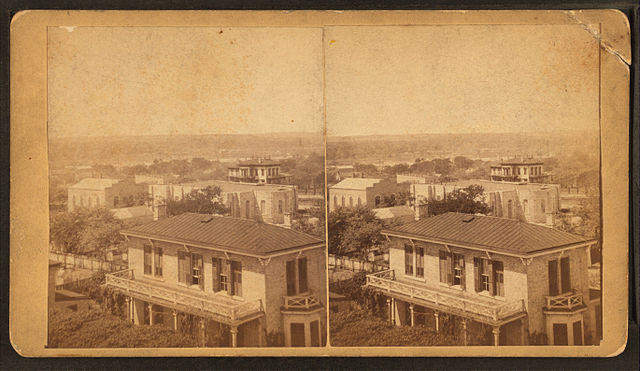
Austin, Texas, c1885
When the pieces start showing up and a man is killed over them, Hewitt gets interested. He guesses that someone somewhere has been stung by the counterfeiter and needs help that he’s willing to pay good money for. Tracing the fake coins to a rancher and his son outside San Antonio, Hewitt begins putting the clues together.

His path quickly crosses that of three other investigators, all of them converging in Austin, and each of them, as it turns out, on the trail of the same counterfeiter. The four join up—but only after Hewitt gets a promise of $30,000 from the Treasury Department if he can deliver the crook, the fake coins, and the die used to create them.

Gold Eagle
One of the investigators is a woman, Mrs. Chaney, the bored widow of a Texas rancher. She’s an amateur, but Hewitt thinks she has promise, and the two become a duo. Reluctantly working with them is a railroad detective, Tommy Quillen, and Dennis McGucken of the Treasury Department.

Character. Hewitt is a curious creation, not exactly a warmly congenial man. At one time a Pinkerton detective, he’s now self-employed and always calculating the profitability of the cases he takes on. He is adept at sizing up people and situations, drives a hard bargain, and has killed four men in his line of work.

Thursday, September 26, 2013

John Reese, The Wild One (1972)


What I most enjoy about a John Reese western is how he takes the conventions of the genre and makes them completely unpredictable. The conventions this time are right there on the cover from the title to the artwork to the tag line:

He was a boy in a man’s boots, packing a man’s gun, and sitting in a man’s saddle when he went riding into strange country…

All familiar and all true as far as they go. But try to guess what actually happens between the covers of this novel, and you’ll be mistaken.

Plot. Its plot is the basic bildungsroman (and there should be a simple word for that in English), a story about the moral and psychological growth of a novel’s main character. You see it over and over in westerns, a young man in his late teens forced by circumstances to take on the responsibilities of adulthood. It usually involves a crisis in which he leaves home and has to prove his mettle, usually with the use of a gun.

That character in this novel is Henry Ely, almost 18 years old, who is already flirting with trouble when we meet him in chapter one. Despite his mother’s warnings, he’s saddling up to meet with a neighbor’s wife for what he half expects will turn into the loss of his virginity. By the end of chapter two, he’s been hunted down by her husband and three sons, who beat him to within an inch of his life.

Thus begins an odyssey that takes him from Texas to a godforsaken settlement in New Mexico, where he gives himself another name, Jack Neely, and takes a job with a horse trader. There he inadvertently crosses a gun slinging outlaw, beats him in a fistfight, and eventually has to defend himself in a gun duel. Having developed nerves of steel by this point, he develops a reputation as a man-killer.

Nebraska Sandhills
Before long he is working as a foreman for a large cattle and sheep ranch in Wyoming, where he yearns to be his own man. That means running his own business. He has a dream of breeding mules using mustang mares. A partner has his eye on a ranch for sale in the Nebraska Sandhills, if they can somehow raise the money. And there’s this nice little bank waiting to be robbed.

And so on, through several more chapters, as the plot careens onward taking one unexpected turn after another. At the end, Jack (now Henry again) emerges from it all a grown man, having shown his grit by weathering several crises, including the loss of his virginity.

Characters. What makes all this work so well has a lot to do with how strongly characters drive the plot. Henry, as just one example, is so clearly a one-of-a-kind individual. A complicated guy, he doesn’t care whether or not you like him. He’s unsentimental and bonds with other people only as far as he can trust them. Which is not a lot.

Thursday, September 5, 2013

John Reese, Rich Man’s Range (1966)


This is an old story that is often retold in westerns. Like Odysseus of old, a man returns home after many years of wandering. There he finds his house in disorder, and heads must roll before he can be reunited with the woman he once left behind. Reese may or may not have had The Odyssey in mind when he wrote this novel, but the parallels are many, and he’s given them a sly twist or two.

Plot. After an eight-year absence, George Merrit finds his way back to Strickland, Texas, where he has inherited half a 40,000-acre ranch. The other half has been willed to the widow of the previous owner. A high-strung woman, Bonnie Keller has never forgotten her humble origins as the daughter of “movers,” whose gypsy habits once branded her as white trash. Before marrying the now-dead rancher, she was also at one time Merrit’s lover.

Like Penelope in Homer’s epic poem, Bonnie has her suitors. One of them is the psychopathic manager of a neighboring ranch, Aaron Davidson, who wants to get his hands on her property. Seems her ranch is about to jump in value as a new railroad is being built across it, and he needs money to pay off an embarrassing debt.

In Homer’s version, Odysseus enlists the assistance of his now-grown son, Telemachus, to help retake possession of his home. The hero in Reese’s novel discovers only after his return that he has a son, a boy who unfortunately died in infancy. To take on Davidson, Merrit gets help from another suitor instead, a lawyer named Newton Price, who quotes Shakespeare and is rarely sober.

Also coming to his aid are the ranch’s cowhands, three amigos from his years as a gold miner in Sonora, and several Mexicans, who turn out to have an agenda of their own. On Merrit’s behalf, Price brings a suit against Davidson for conspiracy to defraud. And for a while the story turns into a bracing courtroom drama enlivened with charges made by the battered madam of the local whorehouse.

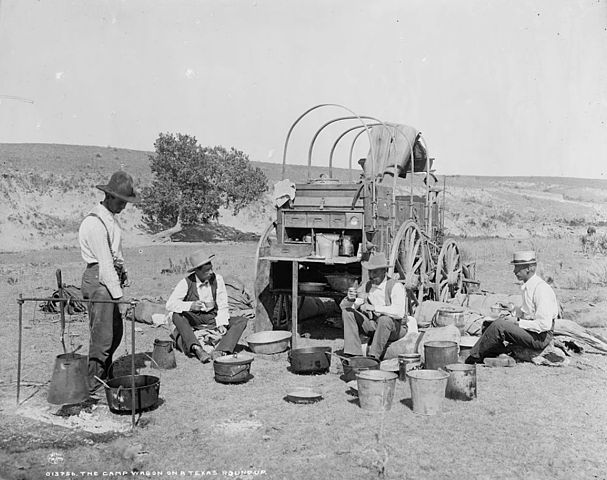
Roundup camp, Texas, 1900
A great deal happens in this short, tightly plotted novel. Readers who like action are treated to fisticuffs and gunplay, with more than a few casualties. Hostilities escalate until the villainous Davidson mounts a full-scale attack on the ranch and is finally captured and rendered quite dead by Merrit’s hired Mexicans.

Style. I would call this an adult western, and not just because of the whores and mention of venereal disease (referred to as being “laid up”). The stormy relationship between Merrit and the widow is fraught with recriminations, sarcasm, tears, and racy sexual undercurrents. When the two have a scene together, the soapy dialogue gets pretty trashy as injured pride reaches for all the clichéd accusations and rejoinders. Matters may even get physical, and not in a nice way.

But when Reese is not knee-deep in the battle of the sexes, the writing is sharp and original, often salty. Here the narrator sums up Bonnie’s family background:

The riffraff she was born into called themselves horse-traders, but anything they had that was worth trading was stolen. Their men were deadbeats, thieves, so lazy they stank.

The story moves forward at a brisk pace. The first chapter is breathlessly packed with character and incident as exposition is deftly woven into the narrative. Throughout the novel, there are mysteries about the past that are revealed without warning. You have to pay close attention or the details can slip by you.

Thursday, April 18, 2013

John Reese, The Land Baron (1974)


This is the third book in the trilogy, Jesus on Horseback, John Reese’s tribute to his fictional frontier community, Mooney, Colorado. Reese was a reporter and labor editor for William Randolph Hearst’s Los Angeles Examiner, and he is like other western writers who worked in the news business. He has that particular understanding of community that crosses social boundaries and divisions. He knows that despite upstanding facades, crooks and phonies abound. And his opinion of the human condition ranges from salty skepticism to heartfelt sentiment.

Plot. Like other writers, Reese has insisted that plot springs from the characters that populate a story. The Land Baron is chock-full of them, each sharply and often humorously drawn. The man at the center of it all is Sheriff Abe Whipple, and in his role as an officer of the law, his duties make him an attentive observer of the lives of everyone else in Mooney.

The central storyline concerns the arrival in Mooney of a land speculator, Asa R. St. Sure, known to one and all as “Tapeworm.” Full of birdshot from an unknown assailant when we first meet him, he is the sad case of a man who’s come west hoping for a change in a string of bad luck—only to find more of it. Who-shot-Tapeworm becomes the thread on which depends the many people and incidents that make up the novel.

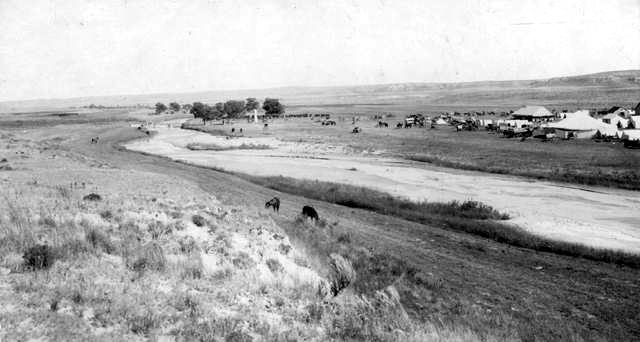
Prairie, northeast Colorado, 1917
The wheel of fortune turns for Tapeworm when he comes upon inside information that the railroad is building a spur into town. With his oldest daughter’s inheritance from his first wife, he snaps up whatever real estate he can get his hands on. He’s also developing commercial properties in anticipation of the boom he expects the railroad to bring.

Among the cast of characters is his daughter, Virginia, whose fish-out-of-water husband runs off with a carnival performer. When one-armed Elmo Huger, an outspoken Baptist, takes on work as her ranch foreman, he’s humiliated when she freely admits that he’s assumed the place of her former husband in her bed.

There’s a 71-year-old Englishman, Dickerson Royce, who does nothing but drink up a quarterly remittance. A villain, Mike Timpke, who lurks mysteriously on the sidelines, manages to live as an outlaw though he is terrified of guns. There’s Alec McMurdoch, banker and former cowboy, whose horse loses a high-stakes race while he’s trying to take a piss in the weeds with an enlarged prostate. And so on.

Sod house, 1901
Narration. The novel has a narrator, Pete Heath, who has a little ranch outside of town where anyone from immigrants to fugitives can take shelter for a few days, maybe trading horses, no questions asked. You catch his voice now and then in his slightly ungrammatical use of English, with words like “retch” (reached), “catched,” and “overhalls,” and expressions like “He done it.”

Pete is a repository of rumor and local scuttlebutt. Sheriff Whipple may drop by for his opinion on a matter, given whatever news might have reached Pete’s ears. In the few scenes like these, the narration slips into fist person, and it’s a little surprise to be reminded that we are being told a story by someone in the story itself.

Reese achieves a clever sleight-of-hand, by having a marginal character who is also an omniscient narrator. The segues between third- and first-person narration neatly place the novel in an older, oral tradition. Like stories told around the campfire, liberties are taken by the storyteller who pretends to know what someone was thinking, saying, and doing, though they were not present as a witness. And we happily suspend disbelief.

Wednesday, January 2, 2013

John Reese, The Blowholers (1974)


Blowholes are like sand traps provided by nature’s own hand. They are created by erosion, where a patch of top soil has been stripped by overgrazing and wind from a sandy under layer. You find them in regions of the high plains. You also find them in this darkly comic novel from the hand of western writer John Reese.

Plot. The blowholers of the title are a gang of four brutal low-lifes who savage a family of “movers,” so-called because they live a gypsy existence on the frontier. The father and sole parent of three children is murdered, and one of his daughters is fatally assaulted.

Almost as low as blowholers and movers on the social order is Ownie Cope, a jobless drunkard who lives with the novel’s narrator, Pete Heath. Cope is so outraged by the ruthlessness of the crime that he gives up drink and sets out on the “vengeance trail” in pursuit of the gang.

It takes Ownie half the novel to gather enough clues to even begin tracking the villains. Disguised as a mountain man, he pursues them from the scene of the crime to Denver. One by one they meet a violent end, though ironically not at Ownie’s hands.

Denver, Colorado, late 19th century
After his close encounters with death, Ownie learns that he lacks the stomach for killing the one remaining villain. He also realizes that he lacks the character a man needs to be dealing out justice at the point of a gun. Taking up a lawful occupation, marrying a girl who loves him, and becoming an upstanding member of the community, he acquires the self-respect that has always eluded him.

Layering ironies upon ironies, Reese finally gives Ownie the opportunity to avenge the atrocity committed by the blowholers. The last survivor, an aging gunslinger named Doc Harper, appears in town, and the novel ends with a classic gun duel.

Counter-plot. The pleasures of a John Reese novel are only partly the thread of plotline that holds it together. For much of the novel, you are only half sure of the plot anyway, because Ownie is only one of several characters, none of whom really know what he’s up to. That includes the narrator, Pete Heath, who never expects Ownie to be more than the town drunk.

Colorado, 1874
Reese has created an ensemble of characters, some of them already introduced in an earlier novel, Angel Range, reviewed here a while ago. Having read that novel, we already know Sheriff Abe Whipple, Deputy Thad Rust, the parson Rolf Ledger, wealthy rancher Cal Veneman, and others. They weave in and out of the story, along with the newcomers.

Incidents in the novel make up what is really the life of the community itself. They only happen to contribute to the development of the plot, and often without our full awareness. There’s a long build up to the revelation that one of the villains spoke with a Scots brogue. This involves the transaction of a sale of cattle that threatens to invade the streets of town with the herd that’s changing hands.

While the cowhands are in town, one of them gets shot in the leg, which calls for a trial, which in turn calls for pages of comic maneuvering by the attorneys, the judge, and the sheriff. The trial itself, when it finally comes, takes unexpected turns of its own. The outcome, of course, has no bearing at all on the hunt for the villains of the novel.

Wednesday, November 21, 2012

John Reese, Angel Range, 1973


This novel was first published in 1971 as volume one of a western trilogy called Jesus on Horseback. By then, John Reese (1910-1981) had been pouring out stories for 30 years in the magazines. At the age of sixty, he was now publishing the first of many novels.

Reese, as I’ve noted here before, brings a number of quirky gifts to western storytelling. He seems to enjoy scrambling the elements of the traditional western, mixing in a good deal of wry humor, while keeping his characters grounded in a realistically described world.


Plot. In this novel, a cowhand, Rolf Ledger, has just been released from prison and is looking for a job at a ranch in northeast Colorado. A sheriff arrests him, though it’s clear he isn’t the man his posse is looking for. Seems Ledger served as a chaplain’s assistant in prison, and the folks of Mooney County are in immediate need of a cleric to officiate at a funeral.

Never ordained and never even called, as he continues to remind the sheriff and anyone who’ll listen, he reluctantly agrees to help out. The burial candidate was not only a prominent citizen but the victim of a killing. Nearly everyone in the vicinity shows up for the funeral, including a madam and some girls from a local whorehouse.

Pleasant Park, Colorado, 1870
All but an upright Methodist, who objects to the whores, are comforted by Ledger’s sermon. Given the local shortage of men of the cloth, he is pressed to stay on. Then when some amateur doctoring saves the life of a resident, he gets an unwelcome reputation as a faith healer—maybe even an angel. Northeast Colorado ain’t no “angel range,” he insists, but you can’t stop rumor.

He moves in with an unmarried rancher outside of town who has an obsession with stringing barbwire fences. By degrees he becomes involved in the affairs of another rancher whose cattle keep disappearing thanks to persistent thieves. And he finds himself instrumental in the hurried marriage of the sheriff's deputy and the ranchers daughter, who discovers shes going to be a mother. In an amused detail, Ledger is embarrassed by use of the word “pregnant.”

Meanwhile, the rancher’s other daughter wants to know if Ledger believes in evolution. She knows her Darwin and won’t hear any creationist hogwash about the origin of species. For his part, Ledger isn’t even sure he believes in God. They are an unlikely pair, but they’re destined to be drawn together in this backwater neck of the prairie.

A train wreck and the surprising deaths of two crewmembers uncover more nasty work of the thieves. Ledger uses his own connections as a former outlaw to solve the mystery and bring them to justice. Then, in the rough ecumenical spirit that pervades the novel, Ledger gives last rights to an elderly priest who is shot as a lynch mob attempts to break into the jailhouse to carry off a prisoner.

Monday, October 8, 2012

John Reese, Sequoia Shootout (1977)


This novel from western writer John Reese is a mix of unexpected elements. You know you are in the Old West from the first paragraph, and you know what’s at stake by the end of the first chapter. The central character, Jefferson Hewitt, is on the trail of a vicious scoundrel known as Durango Slim.

What transpires between their first encounter, a near fatal ambush, and the final shootout between them in the Sequoias of California is as unpredictable as the deal of a poker hand. Maybe it’s the revisionist 1970s, when the novel was written, but Reese seems to enjoy playing with the conventions of the genre so that you’re always being set up for a surprise.

Plot. Hewitt is after Durango Slim because the man is a white slaver. He has lured at least three very young women—girls—into prostitution. Two of them wind up dead. Hewitt rescues a third one in time to put her on an eastbound train out of harm’s way.

Sequoia, California, 1908
The man is especially dangerous because he is such a crack shot with a rifle. He’s an associate of a California lumberman, Creed (sounds like “greed”), who is building a commercial empire on the proceeds of human trafficking. He’s been selling women into the lucrative Asian market as sex workers.

Playing with expectations. As one example of Reese’s sleight-of-hand style of storytelling, there’s the identity of Hewitt himself. For several chapters, he seems a conventional hero of western fiction, a lone man driven by his own code of honor to bring justice where it’s needed.

He is down to his last few dollars, poorly dressed and outfitted. He seems at a decided disadvantage in his pursuit of a cunning and heartless gunman. He hires on a man, O’Hara, who will help him track Durango Slim—if he can just keep sober. Following a trail into the Sierras, the two are an unlikely team who promise to eventually get their man after 150 pages of overcoming the odds.

Then it turns out the odds aren’t what you think they are. Hewitt reveals himself to O’Hara as a partner in an indemnity and bonding company. His partner, in Cheyenne, does all the office work and Hewitt does the fieldwork.

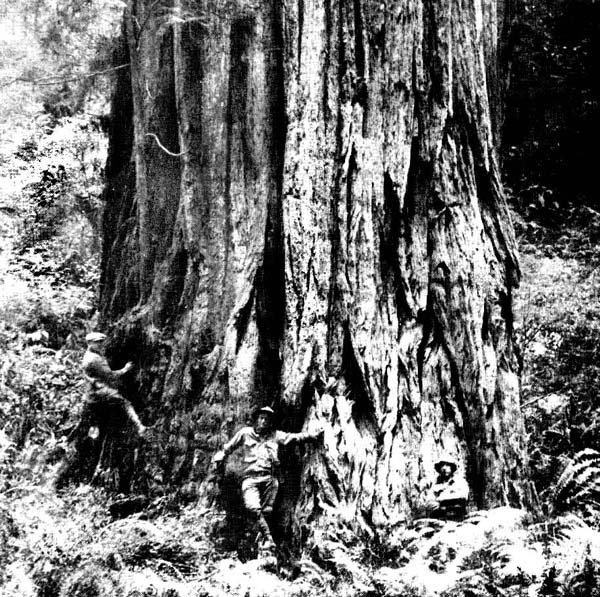
Stereoptican, Northern California woods, c1900
Money is not a problem. If he dresses like an out of work cowpuncher, it’s because he likes it that way. It’s one of many personas he likes to play. Not only that, we learn that Hewitt is just one of many aliases he uses.

Wrapping up. This Double D western is one of dozens from Reese (1910-1981), who wrote most of his novels in the 1970s when he was in his sixties. Sequoia Shootout is the sixth of ten novels featuring his character, Jefferson Hewitt. Earlier, starting in the 1930s, he published scores of stories in both pulp and slick magazines. He grew up in a rural community in the Nebraska Sandhills.

His novel Halter-Broke (1977) was reviewed here recently. His Saturday Evening Post story, “Frontier Frenzy” (1958), was the basis for a Fred MacMurray western, Good Day for a Hanging (1959), also reviewed here.

Sequoia Shootout is currently available at amazon, Barnes&Noble, and AbeBooks

Sources:

Image credits: Wikimedia Commons

Coming up: Danny Glover, Buffalo Soldiers (1997)

Monday, September 10, 2012

John Henry Reese, Halter-Broke (1977)

Nebraska does not have a lot of homegrown writers, but you can certainly add western-writer John Reese (1910-1981) to the list. Born in Sweetwater, on the fringe of the Sandhills, he knew frontier old-timers who remembered the 1880s and 1890s. The oldest of six children, he described his father as a horse breaker and former cavalryman. His mother was the daughter of a blacksmith and woodworker.

Sweetwater is a wide spot in the road in north Buffalo County, in central Nebraska. It’s on Highway 2, next to the Burlington Railroad line, which today hauls coal from strip mines in Wyoming. Nearly as remote a place on earth as my own humbly rural origins some 50 miles to the east, it gives me a particular feeling of kinship with the man.

Reese was a prolific writer and a good one. He produced hundreds of stories that were published in pulps and slicks, including The Saturday Evening Post, plus numerous novels, mostly westerns. His widely praised and wonderfully named Jesus on Horseback trilogy dates from 1971, and he also produced the long-running Jefferson Hewitt series (1973-1980).

Farmstead, Buffalo County, Nebraska, 1903
Plot. Halter-Broke is a short novel that is cleverly constructed of different kinds of plot elements and an ensemble of characters. Rather than a central plot, it closely interweaves the threads of several stories, so that as a reader you’re always a little unsure how the pieces are going to come together. But come together they do in a way that’s both darkly comic and leavened with sentiment.

Reese’s familiarity with rural western attitudes and people, his knowledge of horses, and the sparks that flare up between the genders combine here in a perfectly believable way. Add to that the mechanics of well-digging, and you know we’re in the hands of a writer with his boots on the ground.

There’s also a playful kind of bait and switch with readers’ expectations as characters you don’t immediately warm to turn out to be OK after all. They don’t change or redeem themselves. By the end of the novel, you just get around to seeing things their way.

Bridge over Mud Creek, Sweetwater, Nebraska, built 1909
Character. The central character in this case is Alec Pitman, a well-to-do rancher, kind of a hardass and plain spoken, who has worked himself to the bone over the years. He’s unmarried, thirty-something, and has the worn look of a much older man. Oh, yes, he’s under the thumb of his domineering mother, who can’t abide the one woman he cares for, a young widow, Mrs. Butterworth, who owns a neighboring ranch.

Actually, “cares for” doesn’t quite describe his interest in her. He wants her ranch, too. And he isn’t so much sweet on her as he'd like to involve her in some good old-fashioned lovemaking. These feelings are further complicated by his rivalry with another rancher, a maybe shady guy who is courting her by digging a new well at her ranch.

That’s only one thread, and mixed together with it is Pitman’s foreman who’s a few bricks shy of a load, a runaway boy who has “walked down” a horse, two villains who have brutally murdered a local blacksmith and his wife, an old-timer living in fear of a younger partner with plans to take his ranch away from him, a doctor/coroner, and a played-out sheriff.

John Henry Reese
Wrapping up. If there isn’t a John Reese cult, there should be. The guy understands the western and puts a spin on it that’s full of surprises and poker-faced amusement. In the midst of the comic world he creates there is bloodshed and some nasty violence. The mix shows a wryly-entertaining intelligence at work. I intend to read more of his work and will review it here.

Reese’s novels are out of print and used copies can be found at amazon, Barnes&Noble, and AbeBooks. Several titles are available online at OpenLibrary.

Photo credits:
Author’s photo, goodreads.com
Sweetwater bridge, fhwa.dot.gov
Farm family, loc.gov

Coming up: Audie Murphy, 6 Black Horses (1962)