Showing posts with label old west. Show all posts

Monday, January 7, 2013

John Williams, Butcher’s Crossing (1960)


Some would call this an anti-western. It reflects the dark underside of the 1950s and overturns some of the mythology of the West. It’s central character is a young man who flees the deadening effects of civilization as it’s practiced in 1870s Boston and heads out West to find adventure on the frontier.

William Andrews is 23 years old and wants above all to experience the wildness of the West, to immerse himself in its freedom. In that freedom, he expects to find goodness, hope, and vigor. He is a living example of Emerson’s belief in self-reliance and the wholesomeness of unspoiled nature.

Plot. Arriving in a settlement called Butcher’s Crossing, in central Kansas, he bankrolls a bison hunter who claims to know of a hidden herd in the mountains of Colorado. Bison hides are selling for $4.00, given market demand and the growing scarcity of the animal. Not only will the hunt be an adventure, it will turn a profit of thousands of dollars for them.

The trip to Colorado and back, with three experienced hunters, turns into an unexpected odyssey of many months. The party is headed by Miller, who is expert with a buffalo gun. He hires an experienced skinner, Schneider, and persuades the older Charley Hogue to go with them as driver of their oxen-drawn wagon. Andrews is to help with the skinning.

Bison hide yard, Dodge City, Kansas, 1878
It takes weeks to travel across western Kansas and eastern Colorado. Taking a shortcut across the arid prairie, they run out of water and nearly die of thirst. All the time, until Miller finds them, there is doubt that his herd of bison even exists.

But they do exist, in the thousands, surviving summer by summer in a mountain valley. Finding them, Miller gets right to work, and before long the hides pile up far beyond the number they can take back in one trip to Butcher’s Crossing. Over Schneider’s objection, Miller stays on, intending to wipe out the entire herd.

But he waits too long, and they get snowed in. The final third of the novel is an account of their fierce struggle to survive the winter. With the hides, Miller constructs a shelter and “sleeping bags” for them to keep from freezing to death. They live on game and a carefully rationed supply of coffee.

When enough snow has melted from the mountain pass leading out of the valley, they pile the wagon high with hides and head back to Kansas. That journey is marked by an accident that reverses their fortunes once again. Yet more bad news awaits their arrival at Butcher’s Crossing.

Dead bison in snow, 1872
History vs. myth. The killing off of the bison herds is an accepted fact of western history, but seldom if ever has it been the subject of a novel. Williams describes grimly but matter-of-factly the systematic conversion of thousands of living animals to skinned carcasses. Somehow, none of the men regards what they are doing as the extermination of a species.

Meanwhile, the relentless killing and skinning has an effect on them more deadening than the worst to be had in tired old civilized Boston. Andrews is first physically repulsed as he butchers one of the animals. He desperately washes the blood from himself and his clothes in an ice-cold mountain stream. Then he gradually succumbs to the machine-like process of slaughter.

He half realizes that instead of the thrilling excitement of living wild and free, he is being numbed by death and bloodshed. The irony is that the myth itself does not die for him. By novel’s end, he heads off again westward, with no destination in mind, but only a belief that he will eventually find what he is looking for.

Friday, September 14, 2012

Edgar Beecher Bronson, Reminiscences of a Ranchman, 1908

1910 edition
Edgar Beecher Bronson (1856-1917) was one of those larger than life writers and adventurers of the 19th and early 20th century. Born in Pennsylvania, he began as a youthful newspaper reporter for The New York Tribune. At nineteen, he was already a model of nerve and persistence. Covering the 1875 Henry Ward Beecher adultery trial in Brooklyn, he crossed the ice-covered East River on foot with his report when there was no boat to ferry him over.

Bronson was a member of that “strenuous” generation praised by Theodore Roosevelt. He anticipated TR’s interest in the West by giving up his reporter’s job and going west to cowboy and then take up ranching. This book is his memoir of that frontier adventure.

The new outfit
Cowboy to rancher. Through a connection with field geologist Clarence King, he found his way to a horse ranch in Wyoming where he endured several months as a tenderfoot among seasoned punchers. His accounts of rising to the challenge show him remarkable for his tenacity, eventually winning the respect of the other men and his employer.

Before long, he is in Texas, buying up cattle to drive north, with the intention of ranching on the plains. Still in his early twenties, he is out of his depth dealing with dishonest traders and trying to boss trail hands who resent his lack of experience and his Yankee origins.

Holding his herd in Wyoming, he is one of the first cattlemen to venture north of the North Platte River. He winters there with several of his men in a dugout near Fort Laramie. The structure is 18-feet square, with rawhide mattresses in the bed frames, a fireplace, a mountain lion skin on the floor, and tomato can cases nailed to the walls for shelves.

"Shet y'r yawp."
He has problems in Wyoming with rustlers, who take 70 or more of his cattle to Deadwood. In that wild mining camp, over 200 miles away, meat on the hoof is worth a small fortune. Catching a night coach, he is able to track down his cows and, after some hard bargaining, buy them back from a shady and threatening butcher.

By 1877, he has settled in the Nebraska panhandle, just south of Fort Robinson, hundreds of miles from any duly constituted authority. He is on his own, with 8-10 ranch hands, to keep cattle and horses on his range and out of the hands of rustlers and the Sioux.

Chief Dull Knife
Indians. With the Sioux resisting efforts to move them off their traditional lands, and Custer's recent encounter with them at the Little Big Horn, there is also the risk of retaliation. Bronson has several moments in tight spots with them when he’s fully aware that he may be breathing his last.

His understanding of the dilemma faced by the Indians makes him largely sympathetic with them. He admires their courage and ingenuity and gives a long account of Dull Knife’s breakout from Indian Territory. The tribe’s amazing trek northward defied multiple efforts of the U.S. government to intercept them. Fighting valiantly to the last in bitter winter cold, starved and scarcely clothed, they win Bronson’s unreserved respect.

Two chapters are devoted to what Bronson believes are the last Sundance ceremonies by Sioux tribes gathering at the agency near Fort Robinson. There in the spring of 1880 or 1881, he and several other whites observe days of rituals and dancing by an assembly of 10,000 Ogallala Sioux and 2,000 Brules.

Mutiny
Moving on. In 1882, at the age of 26, Bronson saw the writing on the wall. The range was getting overstocked, and homesteaders were arriving in droves. He’d had five good years and knew that staying on he chanced being wiped out by a killing winter. Against the wishes of his loyal cowhands, who were ready to take up their guns and drive the nesters out, he sells the ranch and returns east.

His last summer on the prairie finds him in Ogallala, Nebraska, at the height of its rip-roaring bad old days. There, with one hotel, 20 saloons, dancehalls, and gambling joints, all in a single row facing the railroad tracks, the town is surrounded by the herds of 12 or more trail outfits. He estimates that there are 20-30,000 cattle fresh from Texas.

The fierce, triple-digit heat gives way to a sudden storm front, which sends the temperature down 40-50 degrees F. After torrents of rain, the river floods, driving residents in the hotel to the second floor, raising fears that the whole town will be swept away. A tornado is sighted in the flashes of lightning, but it misses the town.

Monday, July 16, 2012

Old West glossary, no. 37

Here’s another set of terms gleaned from early western stories. Definitions were discovered in various online dictionaries, as well as searches in Cassell’s Dictionary of Slang, Dictionary of the American West, The New Encyclopedia of the American West, The Cowboy Dictionary, The Cowboy Encyclopedia, and The Shorter Oxford English Dictionary.

These are from William De Vere’s collection of poems, Jim Marshall's New Pianner, about mining camps and other western topics, and Herman Whitaker’s The Settler, about a homegrown tycoon on the plains of Manitoba. Once again, I struck out on a few. If anyone has a definition for “two-dealer,” “kerbase,” “Jack box,” “tye camp,” “long-geared,” or “crown a roll,” leave a comment below.

ace in the door = in poker, the ace appearing as the first card turned face up. “It was called by Higgins, who dealt once more, / When the Cherokee got ‘an ace in the door.’” William De Vere, Jim Marshall’s New Pianner.

all hunk = satisfactory, fine. “We’d bin up all night in the dance hall, / An’ closed up the shanty all hunk.” William De Vere, Jim Marshall’s New Pianner.

big bug = an important person, dignitary. “He walked into the door of the hall, / An’ saw all the big bugs dressed up for the ball.” William De Vere, Jim Marshall’s New Pianner.

blow one’s stuff = squander money. “He could play two deuces pat at bluff, / Could ‘crack a bottle,’ or ‘blow his stuff.’” William De Vere, Jim Marshall’s New Pianner.

call the turn = to predict accurately. “That either they or I can learn / A sinner how to call the turn.” William De Vere, Jim Marshall’s New Pianner.

check = a counter, token, chip. “He found he had only one red check, when the game closed.” William De Vere, Jim Marshall’s New Pianner.

clawhammer = a tailcoat. “Rolled home in the morning light, / With crumpled tie and torn clawhammer.” William De Vere, Jim Marshall’s New Pianner.

cold deck = a prepared deck of cards. “The Colonel, in shuffling, slipped the deck through / And the Judge cut a cold one instead.” William De Vere, Jim Marshall’s New Pianner.

con = to study, learn by heart, peruse, scan. “Martin Luther, saith the legend, / Seated in his study grim, / Conning some old Biblic story / When Old Nick appeared to him.” William De Vere, Jim Marshall’s New Pianner.

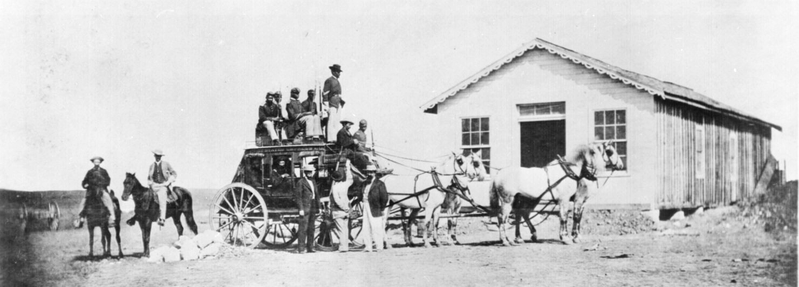
Concord type coach, c1869
Concord Coach = a stagecoach developed in Concord, New Hampshire, and widely used in the Old West; the coach body rested on bull hide strips instead of steel springs. “The old mining camp reached by the Concord coach or the ‘Freighter’ is fast passing away.” William De Vere, Jim Marshall’s New Pianner.

cutter = a light horse-drawn sleigh. “As the cutter sped swiftly over the first mile, she chatted freely, without thought of danger.” Herman Whitaker, The Settler.

deadfall = a rough saloon. “Beware the pine tree’s withered branch, / Beware a ‘deadfall’, called Chalk Ranch.” William De Vere, Jim Marshall’s New Pianner.

fly = smart, sharp, aware. “Once an ole sport, / Of the right sort— / Daniels, by name, / Fly ’n dead game.” William De Vere, Jim Marshall’s New Pianner.

Hell’s half acre = a disreputable area or place, a low-class dancehall or bar. “In fell the roof with a crash, / That sounded as if ‘Hell’s half acre’ / Had tumbled upon us kermash.” William De Vere, Jim Marshall’s New Pianner.

katzenjammer = a hangover. “Woke up next day with a katzenjammer.” William De Vere, Jim Marshall’s New Pianner.

kick = a pocket. “Your overcoat ‘hocked,’ not a cent in your ‘kick,’ / And ‘beautiful snow’ till you can’t see a brick.” William De Vere, Jim Marshall’s New Pianner.

kicking strap = a device worn by a horse to prevent it from lifting its hind-quarters to either kick or buck. “His mate, a rat-tailed mare, equally big, differed only in the insignia of wickedness, wearing a kicking-strap in harness, a log chain in the stable.” Herman Whitaker, The Settler.

knock = to make a good impression. “Just one word more, and that’s what knocks, / There’s always stuff in the parson’s box.” William De Vere, Jim Marshall’s New Pianner.

lookout = the person who supervises betting at faro. “While the ‘lookout’ lazily lolled in his chair, / And his cigarette smoke melted into the air.” William De Vere, Jim Marshall’s New Pianner.

macer = swindler, thief, villain. “Gamblers, miners, suckers, marks, / Spieler, macers, bunco sharks.” William De Vere, Jim Marshall’s New Pianner.

Wednesday, June 27, 2012

Dane Coolidge: photographer


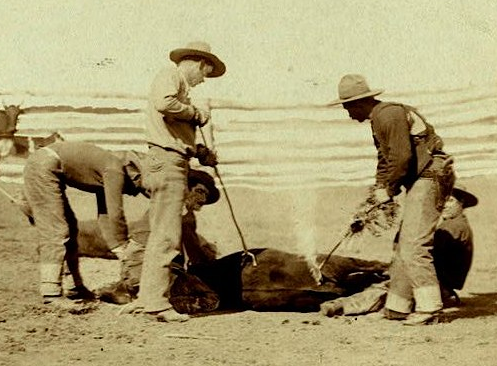
Western writer Dane Coolidge (1873-1940) was also a photographer. Rummaging through old magazines online I came across an article by him about working cowboys in Arizona, fully illustrated with his photographs. The article appeared in a 1904 issue of Sunset Magazine. His book Cowboys of Arizona was published in 1938. His first novel Hidden Water (1910) was reviewed here at BITS a while ago. Find it here.


I like the hip-slung posture of the cowpuncher in the background. I believe it is supposed to be characteristic of the Texas cowboy. You see Paul Newman affecting it in the posters for the movie Hud.


Coming up: Charles Duff Stuart, Casa Grande (1906)

Sunday, May 20, 2012

The Myth of the Code of the West

Cattle drovers, El Centro, California, 1972
Among western fans, a lot of deference is paid to something called “The Code of the West.” There apparently was such a code of behavior on the frontier—more likely several codes. Since they were unwritten, there’s no sure way of knowing exactly what they were.

A popular book Cowboy Ethics with beautiful western photographs by David R. Stoecklein gets mentioned by cowboy enthusiasts, often in connection with National Day of the Cowboy. Its subtitle, What Wall Street Can Learn from the Code of the West, gives a curious twist to the subject. Published in 2004, just before the current economic meltdown, it also sounds more than a little prophetic.

Like the Commandments, the author James P. Owen lays out ten rules of conduct that the book calls “The Code of the West.” His source for these rules seems to be the western movies he has seen (Open Range, Shane), not any kind of historical research. Though he claims to have read a stack of books, there’s no list of them to verify that claim.

I’m not writing this to knock Owen’s efforts to get some accountability in the financial industry, or anywhere else for that matter. But while there may be some truth in it, the problem with his argument is that it’s based so thoroughly on myth.

When western fans evoke the Code of the West, it’s nearly always in service of an argument about an ideal American past when men were decent, honest, and incorruptible. My argument is that outside of a handful of idealists, some cowboys among them, that America never existed.

Land sale poster, Texas, 1800s
If you don’t read, you don’t know this. Over and again, reading early western novels, I find an America that’s little different from today. What you learn is that the urge to get rich quick prevailed. Everywhere, there were people gaming the system to milk it for every dollar they could get.

The land giveaways in the West are a prime example. For all those homesteaders with the best of intentions, there were many speculators with no higher aspiration than to buy low and sell high. Greed built boomtowns that were no more than bubbles engineered by profiteers. There were phony investment companies and banks absconding with people’s savings.

The railroad monopolies had their part to play in all this, luring settlers into the West with false promises and then bleeding them dry with crippling freight rates. They bought legislators and judges to look after their interests. The American West was a free-for-all for crooks, swindlers and robber barons.

Working cowboys. The code-abiding cowboy probably existed to a degree. The best evidence of that is his poverty. He worked and worked hard for low wages, and unless he turned to thievery, there was little alternative, given his lack of education and social polish. To tighten their grip on the cattle industry, cattlemen squeezed cowboys out of developing equity in a herd of their own by turning “rustling” into a crime.

Working cowboys, South Dakota, 1888
We know from reading newspaper accounts of the time that cowboys were regarded as a menace to society. Armed as they usually were, young, and given to drink, cowboys were also prone to high-risk, often lethal misbehavior. Some rebelled against the incursions of Eastern-style law and order. A gang of them, as just one example, gave the Earps trouble in Tombstone.

Historically, it makes more sense to see cowboys as social outcasts. Law abiding or law breaking, they clung to a kind of personal honor that men do anywhere who are disadvantaged and opposed by the same adversaries. The codes they lived by originated before the coming of the law in the West, and they remained mostly extra-legal.

Not that there’s anything wrong with that. Where men administer their own code of conduct, there are rarely any loopholes—and no need for lawyers. That system of justice has a tempting appeal in today's complex world. And its celebration in western movies accounts in large part for their continuing appeal.

But it has nothing to do with a lost America that many western fans believe once existed and yearn for a return to. I would argue that a return to the America of, say, 1885 would find a world little different from our own. Greed, corruption, and malfeasance up and down the social order—and people disadvantaged by them—would prevail as they do now.

And where there was a belief in progress, a hope for a more equitable future would be found everywhere. As we struggle clumsily for that same future today, an honorable code of conduct would do much to making progress toward that goal a reality. But myths about the past won’t do it.

Just my opinion, of course. I’m open to reasoned argument.

Photo credits: Wikimedia Commons

Coming up: Randolph Scott, Man in the Saddle (1951)


Monday, February 13, 2012

Old West glossary, no. 26

Montana cowboys, c1910
Here’s another set of terms garnered from early western novels. Definitions were discovered in various online dictionaries, as well as searches in Cassell’s Dictionary of Slang, Dictionary of the American West, The New Encyclopedia of the American West, The Cowboy Dictionary, The Cowboy Encyclopedia, The Barnhart Dictionary of Etymology, The Oxford Dictionary of Idioms, and The Shorter Oxford English Dictionary.

These are from William Lacey Amy’s  The Blue Wolf, about mysterious goings-on in the Cypress Hills of western Canada, and Gwendolen Overton’s The Heritage of Unrest about the cavalry and the Apaches. Once again I struck out a few times. If anybody knows the meaning of  “wind city,” “The Last Carouse,” or “koon-tan,” leave a comment.


cheese = stop, leave off. “Cheese that cussing, do you hear?” Gwendolen Overton, The Heritage of Unrest.

Dougherty = a horse- or mule-drawn passenger wagon having doors on the side, transverse seats, and canvas sides that can be rolled down. “He had worked himself to such an implicit faith in the worst that he decided that the wide figure, heavily blue-veiled, and linen-dustered, on the back seat of the Dougherty was she.” Gwendolen Overton, The Heritage of Unrest.

Doukhobors pulling plow, Manitoba, 1899
Douks = Doukhobors; a colony of 19th-century Russian immigrants in western Canada. “I don’t know what they are, so I just call them Douks for want of something better.” William Lacey Amy, The Blue Wolf.

fagging = to tire, weary. “It was his way to pick out the roughest possible path before him, to settle within himself that it was that of duty, and to follow it without fagging or complaint.” Gwendolen Overton, The Heritage of Unrest.

furbelow = flounce, ruffles, trimming on a woman’s garment. “I do not know the price of the latest frills and furbelows in London.” William Lacey Amy, The Blue Wolf.

Woman in riding habit
golondrina = a poisonous weed native to the Southwest; used formerly to treat rattlesnake bite. “The little pinto one had died of a rattlesnake bite, from which no golondrina weed had been able to save it.” Gwendolen Overton, The Heritage of Unrest.

habit = a costume designed to be worn by a woman on horseback; riding-habit. “You’re not going to try to ride Ginger in a habit!” William Lacey Amy, The Blue Wolf.

Hamilcar = a general and statesman of Carthage, father of Hannibal. “It’s devilish exasperating, but it’s old as Hamilcar.” Gwendolen Overton, The Heritage of Unrest.

hop = a dance. “The garrison gave a hop in her honor and Landor’s.” Gwendolen Overton, The Heritage of Unrest.

Lambrequins, 1898
lambrequin = a short ornamental drapery for the top of a window or door or the edge of a shelf. “Mrs. Campbell appliquéd a black velvet imp on a green felt lambrequin, and thought.” Gwendolen Overton, The Heritage of Unrest.

manta = a rough-textured cotton fabric made and used in Spanish America. “Much of the furniture, of ranch manufacture, was chintz covered, the manta of the ceiling was unstained.” Gwendolen Overton, The Heritage of Unrest.

Ojo-blanco = white person. “The fighting stopped to watch the Ojo-blanco playing tag with the little Apache.” Gwendolen Overton, The Heritage of Unrest.

Ouida = pen name of English novelist who wrote historical romances. “‘Handsome fellow,’ went on the quartermaster, ‘and looks like a gentleman. Glories in the Ouida-esque name of Charles Morely Cairness.” Gwendolen Overton, The Heritage of Unrest.

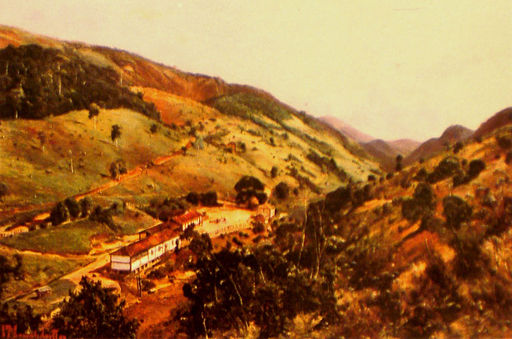
Coffee plantation, Brazil, 1884
Rio = Brazilian coffee, commonly with a strong, rank flavor. “She poured herself a cup of the Rio, strong as lye, with which she saturated her system, to keep off the fever.” Gwendolen Overton, The Heritage of Unrest.

shilling shocker = a novel of crime or violence popular in late Victorian England and costing one shilling. “The Great Powers did not heed them, preferring to take advice from men who did not know an Apache from a Sioux—or either from the creation of the shilling shocker.” Gwendolen Overton, The Heritage of Unrest.

short cut = shredded tobacco. “He drew a sack of short cut from his pocket and filled his brier.” Gwendolen Overton, The Heritage of Unrest.

Officer in slouch hat
slope = depart, move off; leave without paying; escape. “‘You know that is Bill Lawton’s wife?’ he said. Taylor nodded. ‘The one who sloped with the Greaser?’” Gwendolen Overton, The Heritage of Unrest.

slouch hat = a wide-brimmed felt or cloth hat with a chinstrap, commonly worn as part of a military uniform. “He saw her, and without the hesitation of an instant raised his slouch hat and kept on.” Gwendolen Overton, The Heritage of Unrest.

sutler = a civilian merchant who sells provisions to an army in the field, in camp, or in quarters. “He himself was not down with his scouts in the ill-smelling camp across the creek, but had a room at the sutler’s store, a good three-quarters of a mile from the corrals.” Gwendolen Overton, The Heritage of Unrest.

talking wire = Indian term for the telegraph. “The Indians had learned the use of the White-eye’s talking wire very promptly.” Gwendolen Overton, The Heritage of Unrest.

The (London) Times, July 6, 1863
The Thunderer = nickname for The (London) Times. “If The Thunderer should ever send less than thirty-two pages I’m afraid I’d have to read the advertisements in the Medicine Hat Times.” William Lacey Amy, The Blue Wolf.

tizwin = a fermented beverage made by the Apache Indians. “He was badly hurt, with a ball in his shoulder, and he was half drunk with tizwin, as well as being cut in a dozen places.” Gwendolen Overton, The Heritage of Unrest.

touching pitch = to come under a bad influence; from the proverb “He that touches pitch shall be defiled.” “They were taught copy-book morals about touching pitch, I reckon.” Gwendolen Overton, The Heritage of Unrest.

White-eyes = Indian term for white people. “The Indians, being wicked, ungrateful, suspicious characters, doubted the promises of the White-eyes.” Gwendolen Overton, The Heritage of Unrest.


Image credits: Wikimedia Commons

Coming up: James Stewart, Audie Murphy, Night Passage (1957)

Monday, January 2, 2012

Old West glossary, no. 24

Montana cowboys, c1910
Here’s another set of terms garnered from early western novels. Definitions were discovered in various online dictionaries, as well as searches in Cassell’s Dictionary of Slang, Dictionary of the American West, The New Encyclopedia of the American West, The Cowboy Dictionary, The Cowboy Encyclopedia, The Barnhart Dictionary of Etymology, The Oxford Dictionary of Idioms, and The Shorter Oxford English Dictionary.

These are from Honoré Willsie Morrow’s novel The Heart of the Desert about the abduction of a white woman by an Indian, Maria Amparo Ruiz de Burton’s The Squatter and the Don about the fate of a Spanish land grant rancho in California, and Patience Stapleton’s Babe Murphy, about an independent young woman in Colorado. Once again I struck out a few times. If anybody knows the meaning of  “limping piper” or “in the moon,” leave a comment.

basket of chips = a basket made of thin strips of wood interwoven or joined; title of a collection of anecdotes and poems (1888) by noted humorist and poet Joseph Bert Smiley (1864-1903). “My young man carried my carpet bag when I changed cars and saw me aboard all right, as polite as a basket of chips.” Patience Stapleton, Babe Murphy.

bludgy = thieving by violence if necessary. “‘I’m liable to follow Indian tradition and take whatever I want, by whatever means!’ ‘My! My!’ said Rhoda, ‘that sounds bludgy.’” Honoré Willsie Morrow, The Heart of the Desert.

calf’s head jelly = head cheese; a meat jelly made with flesh from the head of a calf or pig and often set in aspic. “It is a good thing, I tell you, ladies and gentlemen, a very fortunate thing, that I am so amiable, and Gabriel so good a fellow, or else I would have punched his head into calf’s head-jelly, twice a day, many times.” Maria Amparo Ruiz de Burton, The Squatter and the Don.

chromo = an unattractive person. “Git onto that old chromo; Beach has got a school marm that will stay this time.” Patience Stapleton, Babe Murphy.

Concord wagon = four-wheeled, horse-drawn wagon or coach for carrying one, two or more passengers; made in Concord, New Hampshire. “I brought the Concord wagon for the women folks and the light spring wagon for the boys and Tisha.” Maria Amparo Ruiz de Burton, The Squatter and the Don.

dogger = a worker performing a menial task. “No wonder nature kicks you out with all manner of illness. You are mere doggers of the machinery.” Honoré Willsie Morrow, The Heart of the Desert.

domino = a large, hooded cloak with a mask covering the eyes, worn at masquerades. “I think the best plan is to wear a domino and mask, as we go in with you ladies, so that you may not be recognized.” Maria Amparo Ruiz de Burton, The Squatter and the Don.

figure-four trap = a simple deadfall animal trap, with supports arranged in the shape of the number 4. “Instead of shooting the rabbit for supper, I’m going to try a figure-four trap.” Honoré Willsie Morrow, The Heart of the Desert.

Thursday, December 8, 2011

Frederick Niven, Hands Up! (1913)

This early cowboy western by Scots-Canadian writer Frederick Niven (1878-1944) is a character study of a frontier outlaw with “good” bad man credentials. Like other train robbers and road agents of western history, he is absorbed into the cowboy culture of the open range between his crimes. There, even should his identity be known, he’s given shelter from the long arm of the law.

Niven, who spent time in the West as a young man, seems to understand this careful balance between observing the letter of the law and loyalty to the Code that preceded it. One often serves justice better than the other. One is a more accurate measure of a man’s character than the other.

The Apache Kid in this case is a decent and honorable man, who happens to rob trains. Even in that vocation, he exercises scruples, cleverly outwitting an expressman instead of shooting him.

Deeply thoughtful, he’s something of a philosopher. Smarter than your average lawbreaker, he knows how to deal with more venal men to get what he wants from them. Nervy and daring, he can volunteer under an assumed name to help a sheriff’s posse track down a gang of cattle rustlers.
  
Knowles Canyon, Colorado
Villainy. The villains and crooks in the story are those men who lack character. And they can be found in both high and low places, including the seats of power occupied by elected officials. No less a man than a U.S. Senator is willing to cut a deal with a convict for his own personal profit.


As the story is told, the crime of rustling cattle pales in comparison with a man’s attempt to rob a woman. Believing her to have come into possession of money, he shows up at her isolated cabin with dishonorable  intentions. As it happens, she is not alone, and he is dismissed at gunpoint.

Meanwhile, a ranch foreman shows his true colors when he fires a new cowhand for using another name beside his own and then reports him to detectives investigating a killing. This behavior violates the Code, whereby a man may go by any name he chooses, and whatever is known about him is never freely revealed to authorities.

Humorously told in many ways, the novel is fully serious about how to judge the worth of a man. Being on the wrong side of the laws that protect the corrupt and the greedy is not enough to brand a man a criminal. Even a sheriff comes to that conclusion when he chooses not to arrest the Apache Kid and then turns in his badge.

Monday, December 5, 2011

Old West glossary, no. 23

Montana cowboys, c1910
Here’s another set of terms garnered from early western novels. Definitions were discovered in various online dictionaries, as well as searches in Cassell’s Dictionary of Slang, Dictionary of the American West, The New Encyclopedia of the American West, The Cowboy Dictionary, The Cowboy Encyclopedia, The Barnhart Dictionary of Etymology, The Oxford Dictionary of Idioms, and The Shorter Oxford English Dictionary.

These are from Frederick Niven’s novel Hands Up! about a tenderfoot and a train robber. Once again I struck out a few times. If anybody knows the meaning of  “wax on one’s fingernails,” “wag the whip,” or “picture soldier,” leave a comment.

arnica = an herbal remedy for sprains and bruises. “Oh I don’t think you need anything much. If you like, a little arnica—three parts water, and bathe that jaw.” Frederick Niven, Hands Up!

big bug = an important person; one who considers himself so. “A man does not become a political big bug without having some kind of savvy.” Frederick Niven, Hands Up!

bootblack tough = a criminal who starts out as a petty crook. “But the men we were after were not ‘boot-black toughs,’ as the West calls such characters who have graduated through picking pockets, knuckle-dusting—in groups—late homing merchants in alleys, breaking open freight cars, to shooting clerk and teller in some small mining camp.” Frederick Niven, Hands Up!

bousy = intoxicated, drunk. “The first thing he knew being landed on his back before his bousy finger could press the trigger.” Frederick Niven, Hands Up!

brass-pounder = telegraph operator. “Scotty, the brass-pounder, over at Black Kettle—the agent—he says Apache went out with them all right.” Frederick Niven, Hands Up!

bring to book = call to account, investigate, punish. “But ‘using his position erroneous,’ as the narrator expressed it, he was brought to book.” Frederick Niven, Hands Up!

bucket = saddle scabbard for a rifle. “The troopers had still their rifles in the buckets, but it was safe for Apache then to let go his hold.” Frederick Niven, Hands Up!

codfish mouthed = open-mouthed; reference to the codfish, which swims with its mouth open. “Pain will teach you how to grip your jaws together and I never heard that a cod-fished-mouthed man was much use.” Frederick Niven, Hands Up!

cold deck = to cheat, to deceive; dealing from a prepared deck of cards. “That sheriff would never cold-deck no man.” Frederick Niven, Hands Up!

cook’s bitch = cook’s helper. “What was you doing at the Diamond K? Cook’s bitch?” Frederick Niven, Hands Up!

cracksman = burglar. “His name only led on to some tale of another brigand, train-robber, hold-up man; or some horse-thief, brand-faker; or townsmen (for I was not the only man at the Triangle who had begun life in a city) would tell of some cracksman.” Frederick Niven, Hands Up!

curve = to travel purposefully or with some urgency. “News of Apache Kid’s presence there reaching Lone Tree, the marshal would have come curving into town with a posse at his heels.” Frederick Niven, Hands Up!

Pre-Raphaelite painting, 1895
greenery-yallery = over-refined, unmanly; reference to the favorite colors, green and yellow, of Pre-Raphaelite British painters and satirized by Gilbert and Sullivan. “So I saw myself, if not a ‘greenery yallery, oh such a good young man’ as—in the phrase of old women—a ‘good son.’” Frederick Niven, Hands Up!

guts = undercarriage of railroad cars on which tramps hitched a ride. “His comrade left him lying there, And took the guts of an Eastbound train.” Frederick Niven, Hands Up!

hair brand = a brand made by burning the hair but not the hide. “You ponder on that and get it fixed proper in you—no hair-brand—but plumb well in.” Frederick Niven, Hands Up!

jack easy = easy-going; a reference to Frederick Marryat’s comic novel Mr. Midshipman Easy (1836). “My father was a queer old fellow. He was a determined enough man, but very ‘jack easy’ as the word is.” Frederick Niven, Hands Up!

jig juice = alcohol, spirits, whisky. “He pikes over to call on the mayor, and sets up the jig-juice to him, pours flattering words in his ears.” Frederick Niven, Hands Up!

kidney = temperament; type. “It was well enough known, he said that representatives of the law and road-agents, and men of such kidney, often (as it is called) ‘josh’ one another.” Frederick Niven, Hands Up!

kittle cattle = capricious, difficult, erratic, rash. “Relatives are sometimes kittle-cattle, and as I did not know how he would take my letter I wearied for a reply.” Frederick Niven, Hands Up!

Boss Tweed, 1869
king bolt = a main or large bolt in a mechanical structure; thus, a leader, boss, kingpin. “He has already got the king-bolt but he wants to round up the whole outfit.” Frederick Niven, Hands Up!

knucklebones = an ancient game, similar to jacks. “Isn’t that just the way ninety-nine men out of a hundred go on dickering with evil week-days and salving it all on Sunday—playing knucklebones with brain, heart, conscience, and what are called primitive instincts?” Frederick Niven, Hands Up!

liquidate = to drink. “We passed into the bar and liquidated.” Frederick Niven, Hands Up!

long clothes = clothing worn by an infant, extending below the feet. “‘Compose myself!’ she cried. ‘And me through the war when you was in long clothes.’” Frederick Niven, Hands Up!

lurcher = hooligan, bum. “It must gall you—that lurcher not being dead!” Frederick Niven, Hands Up!

pass in one’s checks = to die. “He’d have passed in his checks then if you had not stepped in.” Frederick Niven, Hands Up!

pike = to leave, run off quickly. “Apache, who had either played possum for sheer devilment, or wakened up and tumbled—after this fellow piked out—and reckoned it was his long suit, though maybe they didn’t think so—well, Apache had ridden along and cached himself there in the scrub.” Frederick Niven, Hands Up!

push = a crowd, group, gang. “I see—you was broke and so you went on with the Dago push till such times as the white gang would come along?” Frederick Niven, Hands Up!

round robin = A petition or protest on which the signatures are arranged in a circle in order to conceal the order of signing. “They want to quit badly. They’ve filed a petition to him—kind of round-robin.” Frederick Niven, Hands Up!

Smoking concert, 1901
smoking concert = social event for men only with a program of music and comedy and often including drinking. “He who worships a Goddess in spirit and in truth is not likely to slide too often from his chair beneath the table, at a smoking concert.” Frederick Niven, Hands Up!

spread rail = rails spread apart by the weight of a train causing derailment. “I still has faith in the United States, but there’s individuals I don’t trust no more than a spread rail.” Frederick Niven, Hands Up!

spraddle = to sprawl, straggle, spread. “The men who were to drive the herd ki-yied it out, and spraddled it en route, and away they went, herd and beeves, in a cloud of dust.” Frederick Niven, Hands Up!

spring gun = a gun set with a trip wire. “I put spur to my pony so sharply that he leapt forward as if he had been ejected from a spring gun.” Frederick Niven, Hands Up!

stagger juice = spirits. “I got him to sing it three times, him being that full of song and stagger-juice.” Frederick Niven, Hands Up!

storm center = a center of trouble or disturbance. “Black Kettle seems to be getting to be a storm-centre.” Frederick Niven, Hands Up!

tell off = assign to a particular task. “I did my share in the exciting and dirty work of cutting out; and sometimes was told off to lend a hand at the branding during the succeeding days.” Frederick Niven, Hands Up!

time check = notice of termination of employment. “I took the time check from him, tore it into little pieces and dropped it in the sand.” Frederick Niven, Hands Up!

tongue-loosener = spirits. “Some devilment makes me throw a lariat of friendship over him and corral him over into the ho-tel and put tongue-loosener into him.” Frederick Niven, Hands Up!

too green to burn = inexperienced, a tenderfoot. “He’s either plumb locoed, or else he’s too green to burn, or else he’s lookin’ for trouble.” Frederick Niven, Hands Up!

tumble = realize. “It was at this here point that I tumbles to it where they had come from.” Frederick Niven, Hands Up!

Image credits: Wikimedia Commons

Coming up: Frederick Niven, Hands Up! (1913)

Monday, November 28, 2011

Old West glossary, no. 22

Montana cowboys, c1910
Here’s another set of terms garnered from early western novels. Definitions were discovered in various online dictionaries, as well as searches in Cassell’s Dictionary of Slang, Dictionary of the American West, The New Encyclopedia of the American West, The Cowboy Dictionary, The Cowboy Encyclopedia, The Barnhart Dictionary of Etymology, The Oxford Dictionary of Idioms, and The Shorter Oxford English Dictionary.

These are from Caroline Lockhart’s novel Me—Smith. Once again I struck out a few times. If anybody knows the meaning of  “long-geared,” “Mormon lilies,” or “medicine shark,” leave a comment.

Battle Axe = a brand of plug tobacco. “Alkali nothin’. That’s gum-boot, or else a plug of Battle Ax fell in.” Caroline Lockhart, Me—Smith.
  
Bartender, 1862
booze clerk = bartender. “He congratulated himself that he had filled his pocket from the booze-clerk’s sugar-bowl before the mix came.” Caroline Lockhart, Me—Smith.

buck ague = nervousness while taking aim at deer or other game. “Would you get buck-ague in a pinch and quit me if it came to a show-down? Are you a stayer?” Caroline Lockhart, Me—Smith.

bug-hunter = any stranger engaged in scientific pursuits. “He decided to ride over to the MacDonald ranch that evening and have a look at the bad hombre who masqueraded as a bug-hunter.” Caroline Lockhart, Me—Smith.

buzzard head = a useless or mean horse. “Don’t that look like a reg’lar Injun outfit? One old white horse and a spotted buzzard-head.” Caroline Lockhart, Me—Smith.

dead game = never daunted. “You work along with me, kid, and I’ll make a dead-game one out of you!” Caroline Lockhart, Me—Smith.

digger = a crippled horse. “Ralston’s rope, cutting the air, dropped about the neck of the insignificant, white ‘digger’ that had caused it all.” Caroline Lockhart, Me—Smith.

glanders = an infectious bacterial disease usually found in horses. “‘It’s dum nigh as bad as glanders. Catchin’, too, and I holds that anybody that’s got it bad ought to be dipped and quarantined.” Caroline Lockhart, Me—Smith.

hand running = in a row, successively. “I’ve seen myself in my coffin four times hand-runnin’, when I was wide awake.” Caroline Lockhart, Me—Smith.

hunks = even (as in “to get even”). “Smith’ll never rest till he’s ‘hunks’.” Caroline Lockhart, Me—Smith.

lump-jaw = a fungus infection in forage-eating animals, causing swelling of the jaw. “‘Love is a terrible disease,’ Tubbs spoke with the emphasis of conviction. ‘It’s worse’n lump-jaw er blackleg'.” Caroline Lockhart, Me—Smith.
  
Postcard, c1910
make a mash = to seduce someone. “‘He’s makin’ a mash,’ said Ling laconically, as he jerked his thumb toward the open door of the living-room.” Caroline Lockhart, Me—Smith.

make medicine = to hold a conference, plan some action. “I’m goin’ down the road to make medicine with the Schoolmarm.” Caroline Lockhart, Me—Smith.

on the peck = fighting mad. “I’m more er less a dang’rous character when I’m on the peck.” Caroline Lockhart, Me—Smith.

Oregon grape root = a tonic and blood purifier. “Why don’t you bile up some Oregon grape-root. That’ll take most anything out of your blood.” Caroline Lockhart, Me—Smith.

plant = a hiding place for stolen goods. “I’ll go with her. It’s no use for me to get to the plant before afternoon.” Caroline Lockhart, Me—Smith.
  
Oregon grape, 1917
queer = spoil the reputation or chances of a person. “‘Look at that dude,’ said Smith contemptuously, viewing the incident through the living-room window. ‘Queerin’ hisself right along. No more sabe than a cotton-tail rabbit.” Caroline Lockhart, Me—Smith.

quit the flat = leave the country. “I got a lickin’ that wasn’t comin’ to me, and I quit the flat when I was thirteen.” Caroline Lockhart, Me—Smith.

rave and cave = quarrel, complain, object. “I don’t row often, but when I does—oh, lordy! lordy! I just raves and caves.” Caroline Lockhart, Me—Smith.

rip up the sod = have a good time; go on a tear. “When we make a stake, we’ll go to Billings and rip up the sod!” Caroline Lockhart, Me—Smith.

roached mane = a horse’s mane, clipped short. “Have you seen a brown horse, with a star in its forehead, roached mane—” Caroline Lockhart, Me—Smith.